


Block Hole Clash
4.63.71K Reviews
App Specs
- Version
- 1.9.0
- Updated On
- License
- Free
- Downloads
- 1,000,000+
- Developer
- Gimica GmbH
- Categories
- Casual
- Platform
- Android
Screenshots

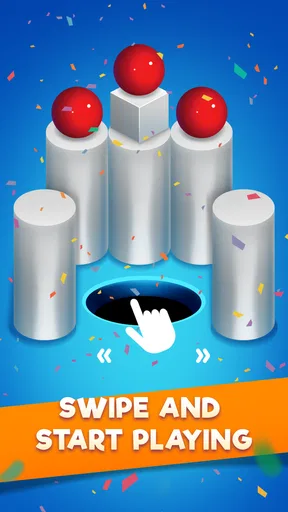
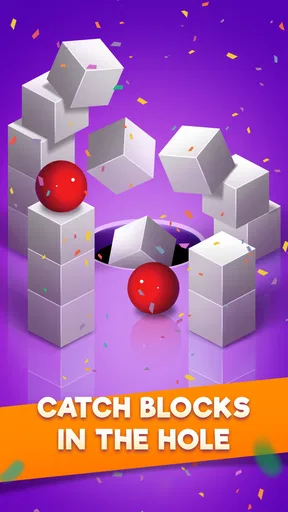
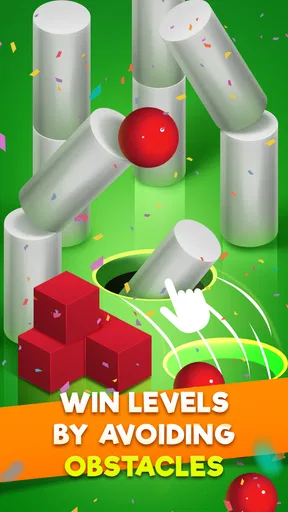
 Analysis by AppCompare
Block Hole Clash is the kind of casual game I open when I want a quick mental break rather than a long session. Its central idea is easy to understand: clear the board by guiding blocks into a moving hole. That simple objective gives each round an immediate purpose, but the real appeal comes from deciding what to remove first and how to avoid leaving an awkward shape behind.
Developed by Gimica GmbH, the game is free to start and aimed at Everyone. It has already passed one million installs, with an average score of 4.6 from around 96 thousand ratings. Those numbers suggest that the straightforward format has connected with a broad audience, but they do not tell you whether it will suit your particular taste. After spending time with it, I see it as a compact puzzle-action experience for people who enjoy visible progress, short attempts, and a challenge that can be understood almost immediately.
How the first rounds establish a clear goal
The opening experience works because it does not bury the main idea under complicated instructions. You look at the board, identify the blocks, and try to position the hole so it can consume them. The early goal is therefore concrete: clear what is in front of you. I appreciate that directness because it lets me start playing without first learning a collection of menus, currencies, character abilities, or lengthy rules.
That simplicity also creates a useful first test. The game is not asking whether I can memorize a large system; it is asking whether I can read space and act in the right order. A block that seems convenient to remove may leave another one difficult to reach. I quickly learned to pause for a moment before moving, especially when several pieces were clustered together. That small habit makes the early stages feel more thoughtful than the basic premise might suggest.
For a new player, the first few rounds provide a natural target without requiring a separate quest structure. Clearing the board is satisfying because the result is visible: the clutter disappears and the level reaches a clean conclusion. This is a good fit for short breaks, including the few minutes before an appointment or during a commute when I do not want to commit to a story-driven game.
The trade-off is that players who need a strong narrative, a character to develop, or a large collection of objectives may find the opening too bare. Block Hole Clash does not try to disguise its focus. It is about the board in front of you, the next decision, and the satisfaction of finishing it.
Progress is felt through cleaner decisions
The most meaningful progress signal is not a complicated profile screen; it is my own improvement in reading the board. At first, I tended to move the hole toward the nearest obvious target. With more play, I started looking at the whole arrangement and planning a route that preserved access to the remaining blocks. That change made later attempts feel earned, even when the underlying action remained familiar.
Worth Reading Before You Choose

EA SPORTS FC Mobile 26 Is a Bigger Football Game, but It Takes Time

Flipboard Shows What News Apps Must Do Beyond the Feed

Switching to Android Auto Means Rethinking Your Driving Routine

Google Calendar Makes a Crowded Week Easier to Manage

Ludo King Makes the Most of the Minutes Between Plans

Baby Panda World Brings Quick Play to Modern Phones, but Its Game Library Feels Busy
This is an important distinction. The game’s progression works best when I treat each cleared board as practice in spatial judgment rather than merely another item to tick off. The visible act of removing pieces gives immediate feedback, while the next challenge encourages me to refine the same basic skill. For casual players, that is a comfortable loop: understand, attempt, adjust, and clear.
One practical tip is to avoid rushing the first move. I now scan for the largest obstruction and consider whether removing a smaller piece first will open a better path. This is especially useful when the board contains a tempting target near the hole but several less obvious blocks could interfere with the next movement. The game rewards that brief inspection more than frantic gestures.
Another useful approach is to separate speed from efficiency. Clearing a board quickly can feel exciting, but a fast move is not automatically a good move. When I slow down enough to predict the hole’s next position, I make fewer corrective movements and preserve more options. That makes the game feel less like random tapping and more like a lightweight spatial puzzle.
There is also a subtle psychological reward in watching an untidy board become empty. It is not the same as building a large collection or unlocking a new character, but it is a clear visual signal that my plan worked. If you enjoy games where improvement comes from better decisions rather than elaborate upgrades, this is one of the stronger parts of the experience.
The challenge curve depends on attention, not complexity
Block Hole Clash begins gently, but the basic rule can become demanding once the board requires more careful sequencing. The difficulty does not need to come from a long list of new mechanics. It can come from arranging familiar pieces in a way that punishes careless movement. That gives the game an approachable curve: I understand the task right away, yet I still have a reason to concentrate.
I found the challenge most enjoyable when a board looked nearly solved but contained one awkward section that forced me to rethink the route. Those moments test patience more than reflexes. They also create a useful pause between rounds, because I am encouraged to analyze what went wrong rather than simply blame the controls.
At the same time, this style of difficulty will not satisfy everyone. Players looking for deep strategic variety may eventually feel that the central interaction is too narrow. The game’s strength is its clarity, and that clarity is also its limitation. It does not offer the same breadth as a larger puzzle game built around several distinct systems.
My advice is to play in short groups of rounds rather than forcing a long session. When I keep going after my attention drops, simple mistakes become irritating and the board starts to feel repetitive. A brief pause usually helps more than repeatedly making the same rushed move. That makes it a better companion for fragmented free time than for an evening-long gaming session.
Where the pacing works and where it can feel thin
The pacing is built around quick feedback. I make a move, see blocks disappear, and immediately understand whether the board is becoming easier or more constrained. That rhythm is effective because there is little waiting between decision and result. It also makes the game accessible to people who do not usually play puzzle titles.
Its retention comes mainly from the desire to solve the next board and improve the way I approach it. The game does not need an elaborate story to create that pull; the unfinished board is enough. When I fail to clear a layout cleanly, I usually want one more attempt because I already understand the mistake and can imagine a better sequence.
That pressure can become less comfortable if you are sensitive to repeated attempts or prefer a clearly defined long-term destination. A casual puzzle can keep me playing through small improvements, but it does not automatically provide the emotional range of a campaign, a competitive ladder, or a collection-based game. I would skip it if my main goal were social competition or a substantial sense of character progression.
The free entry point helps with experimentation. I can install it and decide quickly whether the board-clearing loop fits me before making any commitment. Optional purchases range from $0.99 to $4.49 per item, so I would approach them as convenience spending rather than part of the reason to start. For the best experience, I recommend first seeing whether the core loop remains enjoyable on its own. If it does not, buying an item is unlikely to solve that basic mismatch.
The game runs on Android 7.0 and later, which makes it accessible on a wide range of older Android devices. Its current version is 1.8.0. For someone using an older phone, that compatibility is useful, although actual comfort will still depend on the device’s screen and responsiveness. The controls benefit from enough space to see the full arrangement, so a very small display may make careful planning less comfortable than it is on a larger one.
How it compares with familiar casual alternatives
Compared with match-three games, Block Hole Clash is less about forming repeated patterns and more about controlling position and order. There is no need to search for color combinations in a crowded grid. I am instead asking where the hole should go and which block should disappear next. That makes it a better choice when I want a cleaner spatial task and a weaker choice when I enjoy chain reactions and cascading bonuses.
Compared with endless runners, it is calmer and more deliberate. The challenge comes from reading the board rather than reacting to a constantly advancing environment. I can take a moment to think, which makes it suitable for players who like action with a puzzle backbone but do not want reflexes to dominate every second.
It also differs from large mobile puzzle adventures. Those games may offer richer presentation, characters, maps, and a broader progression structure. Block Hole Clash is more focused and easier to pick up, but its narrow loop means it cannot replace a full campaign for someone who wants a substantial journey. I see it as a companion game rather than an all-purpose mobile hobby.
One non-obvious advantage is how little mental setup it requires. I do not need to remember a complicated build, study a tutorial again, or recover a story thread after a few days away. I can return, look at the board, and start making decisions. That makes it particularly practical for people who play in irregular bursts.
A corresponding weakness is that the same low setup can reduce attachment over time. If I am not in the mood to solve spatial layouts, there is no separate narrative or collection layer to draw me back. The game succeeds when its central action is exactly what I want, not because it surrounds that action with many distractions.
Who will enjoy the loop most
I would recommend it to casual players who like clear objectives, short rounds, and a gradual demand for better planning. It is also a good introduction for someone who normally avoids puzzle games because they look complicated. The basic aim is easy to grasp, while the board arrangement gives experienced players enough room to make mistakes and improve.
It works well in an everyday scenario such as waiting for food at a café. I can play a few rounds, stop without losing the thread of a larger story, and return later with no need to reconstruct a complicated strategy. The same quality suits a short break between tasks, provided I am comfortable with a game that focuses on one repeated type of decision.
I would be more cautious about recommending it to players who need constant novelty, competitive rankings, deep customization, or a strong narrative payoff. Those players may prefer a broader casual title with several modes or a progression system that changes the way each round is played. Block Hole Clash is not trying to be that kind of game, and expecting it to become one would lead to disappointment.
For younger players, the Everyone rating and simple premise make it approachable, but I would still judge it by the child’s patience with repeated spatial challenges. The game is easy to understand, yet “easy to start” does not mean every board will remain effortless. That balance can be a positive learning experience for someone who enjoys solving problems without needing complex instructions.
My verdict on goals, unlocks, and staying power
What sustains Block Hole Clash is a compact progression rhythm: each board presents a fresh arrangement, each successful clear confirms a better decision, and each mistake offers a reason to reconsider the order of play. The early goals are immediate, the progress signals are mostly visual and personal, and the difficulty grows through more demanding layouts rather than unnecessary complexity.
That approach is effective, but it has a defined ceiling. The game is strongest as a focused casual challenge and weaker as a long-term progression project. If you want a title that respects short sessions and lets you improve through observation, I think it is worth trying. If you need extensive unlocks, a campaign, or a constantly changing set of activities, I would choose a more feature-heavy alternative.
My final recommendation is to treat it as a pocket-sized board-clearing game, not as a complete replacement for every other casual genre. Start with the free experience, play slowly enough to plan the first few moves, and notice whether you enjoy improving your route rather than simply finishing quickly. For me, that focused loop is the reason to keep it installed: the satisfaction comes from turning a crowded board into a clean solution with one better decision at a time.
Pros
- Simple controls make it easy for new players to start quickly.
- Short rounds suit quick gaming sessions on mobile devices.
- Colorful visuals give the gameplay a cheerful
- accessible style.
- Collecting and growing the hole creates satisfying moment-to-moment progress.
- The casual format works well for players seeking low-pressure entertainment.
Cons
- Gameplay can feel repetitive after several rounds.
- Difficulty may seem uneven as levels become more demanding.
- Progression may offer limited variety for long-term players.
- Ads can interrupt the experience
- especially between completed stages.
- The game may require patience when larger objects are difficult to collect.
FAQs for Block Hole Clash
What is Block Hole Clash and how is the game played?
Block Hole Clash is a casual arcade-style game centered on controlling a hole that collects blocks and other objects from the playfield. As the hole grows or gains strength, you typically use it to clear more items and complete level objectives. The controls are designed to be simple, making the game easy to start, although later stages may require quicker movement and better planning.
Is Block Hole Clash free to download and play?
Block Hole Clash can generally be downloaded for free on supported Android or iOS devices. However, the free version may include advertising, optional in-app purchases, or other monetization features. You can usually progress without spending money, but purchases may offer cosmetic items, bonuses, or convenience. Check the store listing on your device for the current pricing, available purchases, and regional differences.
Does Block Hole Clash require an internet connection?
The basic gameplay in Block Hole Clash may work without a constant internet connection, which is useful when playing during travel or in areas with limited coverage. Nevertheless, certain features, such as advertisements, rewards, cloud synchronization, updates, leaderboards, or special events, may require online access. Availability can vary by version, so it is best to test the game offline after installation.
Is Block Hole Clash suitable for children and younger players?
Block Hole Clash uses straightforward controls and colorful, non-realistic visuals, so it can be accessible to younger players. Parents should still review the age rating and privacy information before installation because the game may contain advertisements, optional purchases, or links to external services. If children use the device, enabling purchase restrictions and checking the advertising content is recommended.
What should I check before downloading Block Hole Clash?
Before downloading Block Hole Clash, confirm that your phone or tablet meets the required operating-system version and has enough free storage for the installation and future updates. Also review the developer name, permissions, privacy policy, age rating, advertisements, and in-app purchase details in the official app store. Installing from Google Play or the Apple App Store is the safest option.


